
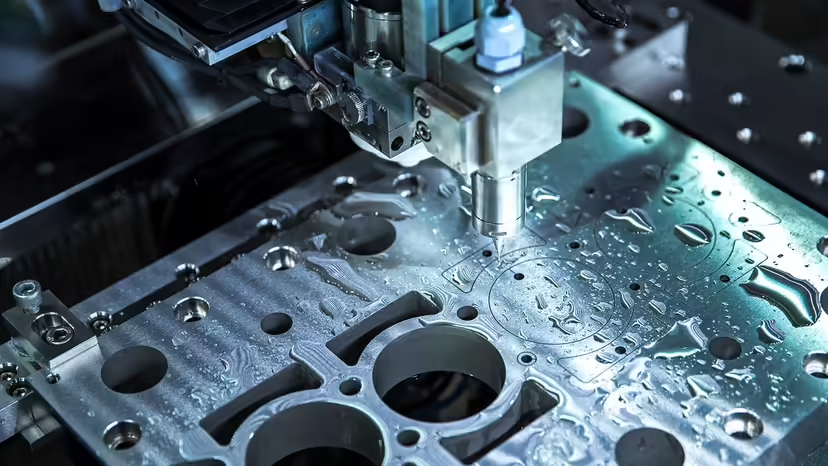
Complex parts do not move from a drawing to a finished component in one simple step. Professional machining services near me follow a controlled process that covers design review, material planning, programming, setup, cutting, inspection, and final delivery. Each stage helps reduce mistakes while keeping dimensions, surface quality, and production timing under control.
1. The Job Starts With More Than Reading a Drawing
Engineers usually provide a CAD model, technical drawing, material grade, tolerance requirements, and expected quantity before production begins. Experienced machining companies near me study those details to identify thin walls, deep pockets, tight internal corners, difficult tool access, and dimensions that may affect cost. Early review also gives the shop time to clarify missing information before material or tooling gets ordered. Practical feedback at this point can prevent a small design issue from becoming an expensive problem on the machine.
2. How Does Material Planning Affect the Final Part?
Material selection determines far more than strength or appearance. Aluminum, stainless steel, titanium, tool steel, brass, and engineering plastics all react differently to heat, clamping pressure, coolant, and cutting speed. Skilled CNC services near me consider those differences before deciding how the part should be held and machined.
Stock condition matters as well. Internal stress, hardness variation, oversized blanks, or poor surface condition can influence dimensional stability after material is removed. Reliable precision machining companies may recommend stress-relieved stock or a different grade when the original choice creates unnecessary production risk.
3. Programming Turns the Design Into a Cutting Strategy
CAM software converts the approved model into toolpaths that tell the machine where and how to cut. Programmers select tools, spindle speeds, feed rates, cutting depths, entry moves, and finishing passes based on the material and geometry. Simulation then checks for collisions, unreachable features, excessive tool extension, and unnecessary machine movement. Careful programming helps CNC machining near me produce complex shapes efficiently without sacrificing accuracy or tool life.
4. Workholding Sets the Part Up for Accurate Machining
Fixtures, vises, chucks, soft jaws, and locating pins keep the workpiece in a repeatable position during cutting. Proper setup prevents movement while avoiding excessive clamp pressure that could distort thin or delicate sections. A custom machine shop may design dedicated workholding when standard fixtures cannot support an unusual shape.
Reference points also deserve close attention. Machinists use defined surfaces or datums to establish where the machine should locate every feature. Consistent positioning becomes especially important when a part requires several operations or must be removed and returned to the machine later.
5. Cutting Is Monitored Instead of Left Unchecked
Production begins only after tools, programs, offsets, and workholding have been verified. Operators watch chip formation, coolant flow, vibration, cutting sound, tool wear, and surface condition as the first component takes shape. Small changes can reveal problems before they affect an entire batch. Active monitoring allows machining services near me to adjust offsets or replace worn tools while dimensions still remain within tolerance.
6. Inspection Confirms More Than Basic Size
Measurement starts with the first completed part rather than waiting until the order is finished. Calipers, micrometers, bore gauges, height gauges, optical systems, and coordinate measuring machines can each verify different features. Detailed checks may cover hole position, profile, flatness, concentricity, perpendicularity, surface finish, and relationships between mating surfaces.
Inspection data also shows whether the process stays stable as more pieces are produced. Trends can reveal gradual tool wear, thermal movement, fixture changes, or material variation before those conditions create rejected parts. Buyers comparing CNC services near me should ask whether the shop performs first-article and in-process inspection in addition to final checks.
7. Final Handling Prepares Parts for Delivery and Repeat Orders
Finished components may still need deburring, cleaning, coating, heat treatment, engraving, assembly, or protective packaging before shipment. Organized machining companies near me keep part numbers, revisions, inspection records, and material information tied to the correct order so different versions do not get mixed. Documentation from the completed job also gives future runs a proven starting point instead of rebuilding the entire process from memory.
Amtec Solutions Group can take on custom machining work that calls for tight tolerances, detailed inspection, and dependable coordination between design and production. Its experience with industrial automation and robotic systems also makes it a practical resource for manufacturers developing specialized parts that must perform accurately in demanding applications.